


◇ Introduction ◇ Function◇ Parameter◇ Product order◇ Download◇ Related products
Introduction
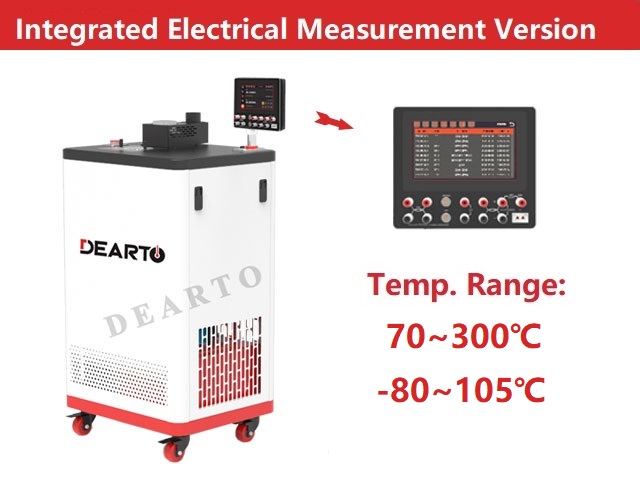
The DTS-EM Smart Refrigerated Calibration Bath with Elec. Meas. is an all-in-one temperature metrology platform integrating high-precision electrical testing, smart thermal control, and automated workflows. It performs indication and switching signal calibration for a wide range of devices, including industrial RTDs, thermocouples, transmitters, temperature switches, temperature controllers, and pressure/bimetallic thermometers. By achieving true Source and Measure integration, it handles sensor calibration, temperature comparison, and electrical signal detection, offering comprehensive multi-purpose functionality.
Product Characteristics
| Sensor Full Lifecycle Management | Comprehensive sensor management:add, delete, edit, view, and copy. Auto-loads formula coefficients for SPRT and RTC sensors based on model and range. Smart sensors: plug-and-play operation,automatic inventory tracking,and clear visual identification. | |
| Module Categories | Electrical Measurement Module 1 | |
| Supports Standard Type | Secondary SPRT(Pt25, Pt100) RTD, SMP, and other smart sensors | |
| Supported DUT Types | ||
| Supports Tested Type | RTD | ITS90 (Cu50, Cu100, Pt50, Pt100, PtX), CVD, IEC60751, Nickel, SMP |
| RTC | S, B, R | |
| TC | K, N, T, J, E, R, S, B, Wre3, Wre5 | |
| Transmitter | DCV, DCI | |
| Temp. Switch | Dry Contact | |
| Integrated Core Hardware Technology | Built-in high-precision electrical measurement unit | Standard 6½-digit and 7½-digit modules (optional accuracy grade); Measures resistance (Ω), DC voltage (DCV), and DC current (DCI); Ultra-high resolution down to 0.1 μΩ, ideal for high-precision metrology tasks. The temperature field and electrical measurement units are deeply integrated at both hardware and algorithmic levels. |
| 4-Wire RTD Constant-Current Reversal Measurement Technology | Separates constant-current excitation from high-impedance voltage sensing circuits. Eliminates lead and contact resistance errors for exceptional measurement. | |
| Cold Junction Compensation Design | Dedicated high-precision cold-junction sensor with multi-point monitoring and intelligent compensation, ensuring highly accurate thermocouple cold-junction measurements. | |
| Automated Calibration Tasks | Indication Calibration | Calibration Items: RTD, RTC, TC, DCV/DCI Transmitter, SWNTC, and other DUTs. When paired with an electronic scanner switch, it enables fully automated multi-DUT calibration for temperature points, repeatability, and deviation—with unlimited temperature points. Raw measurement records are generated automatically. |
| Switching signal Calibration | Supports temperature switches, oil-level/winding temperature controllers, and pressure-actuated thermometers. Supports simultaneous parallel verification of up to 6 channels. Automatically generates heating/cooling sequences to minimize stabilization time, and supports both ascending and descending ramp testing. Task Configuration: Supports configuration of parameters such as ramp rate, temperature point intervals, accuracy class, and ascending/descending test parameters to complete the calibration point setup for switching signals. | |
| Batch Processing & Customized Automation Workflows | Batch Import & Auto-Calibration | Enables batch entry and editing of DUT serial numbers, with template-saving capability. Supports configuration of temperature fluctuation, temperature deviation, and temperature change monitoring thresholds, used for automatic correction and pass/fail determination. Multi-point self-calibration: Configure multiple temperature points at once and start the automated workflow with a single click. |
| Custom Test Sequences | Supports programmable multi-point test sequences that automatically switch measurement modes to execute batch verification, calibration, comparison, and pass/fail determination—fully hands-free. | |
| Intelligent Programmable Multi-Temperature Segment Verification Mode | Two operating modes available as needed: Automatic programming mode: One-click setting of the full-process temperature sequence; the device executes automatically and sequentially. Supports customized delayed start and stabilization hold time. Multi-cycle configuration, automatic control stop upon task completion, unlimited number of temperature points, unattended completion of the entire test and verification process. Manual programming mode: Import temperature sequences for automatic heating and stabilization, supports manual switching of temperature points as needed; Simultaneously supports delayed start, cycle count, and shutdown settings, with an unlimited number of temperature points, facilitating on-site manual review and record comparison/marking. | |
| Adaptive Smart Temperature Control | Dynamically adapts gains to thermal load and medium changes. Selects the best strategy to ensure temperature uniformity and stability. | |
| Multi-channel Synchronous Automatic Acquisition | Once the temperature field stabilizes, the system automatically scans all channels in sequence and synchronously acquires data from both the temperature field and the DUT. It performs multiple ascending/descending readings as required by the regulations and automatically calculates the average, ensuring the objectivity and accuracy of the measurement data. | |
| Regulation-Driven Automated Data Processing | Embeds calculation algorithms from national metrological verification regulations (e.g., JJG 229, JJG 141, JJG 351, JJG 630). Built-in intelligent stability algorithms continuously monitor the temperature change rate and automatically calculate key parameters—including indication error, hysteresis error, resistance, and temperature—eliminating manual computation. Calibration items can be automatically matched with corresponding tolerance thresholds based on the instrument's accuracy class, outputting regulator-compliant calibration results. Supports historical calibration record retrieval, allowing users to access raw data and full project configurations from any past record, with support for exporting raw data sheets. | |
| Real-time Monitoring Throughout the Process | Displays real-time, all-dimensional information including electrical measurement data, temperature field status, operating status, task progress, elapsed time, and stability countdown. In Indication Calibration mode, it simultaneously displays the current temperature point and the current calibration count. Real-time deviation/tolerance calculation, with automatic highlighting of out-of-tolerance data. Monitors the 10-minute fluctuation, maximum, and minimum values of both the standard and DUT channels in real time, with line charts provided for data visualization. | |
| System Management & Data Security | Access Control | Supports tiered access control across three categories: calibration operations, backup and restore, and advanced configuration. Fully compliant with metrology laboratory requirements. |
| Multiple Raw Record Export Options | Export via USB drive, QR code download, or other formats. | |
| System Logging | Comprehensive recording of all verification tasks, equipment operations, and fault/exception events. Automatic logging of operational data for remote diagnostics, enabling fast fault pinpointing and resolution. | |
| Backup & Restore Management | Restore from historical calibration records. Configurable retention period (up to 1+ year); default: 7 working days. Supports data recovery at the individual calibration record level. Once the target record is retrieved, the system can restore the calibration configuration and data state to that specific point in time. | |
| Resume After Power Failure | Equipped with power-loss resume capability. In the event of a power failure, the system automatically resumes the calibration task, retaining previously measured data to prevent duplicate efforts. | |
| Human- Machine Interaction (HMI) & Extensibility | Touchscreen Human-Machine Interface | 5- or 7-inch HD touchscreen & graphical UI. Intuitive operation, minimal operator training. |
| Mass Data Storage & Retrieval | 8 GB built-in storage for 100,000+ calibration records. Advanced combined search (ID, date, project ID, instrument type, calibration date, etc.). | |
| Communication Interfaces | Standard interfaces: RS232/RS485, Wi-Fi, and LAN. Supports USB data export, ensuring long-term compliance and serviceability. | |
| Sustainable Upgrades | In-system upgrade via USB drive for the latest features and regulation revisions. Ensures long-term compliance and serviceability. |
Technical parameters
| EM Series Smart Calibration Bath Specifications | |||||||
| Measurement Channel | Measuring Range | Accuracy | Resolution | ||||
| SPRT Measurement | 0Ω to 400Ω | ±0.002Ω at (0 to 50)Ω ; ±40ppm RD at (50 to 400)Ω | 0.001mΩ | ||||
| RTD Measurement | 0Ω to 400Ω | ±0.002Ω at (0 to 25)Ω ; ±80ppm RD at (25 to 400)Ω | 0.001mΩ | ||||
| TC Measurement | 0mv to 100mv | ±(0.02% RD + 5μV) | 0.001uV | ||||
| DCI Measurement | 0mA to 20mA | ±(0.02% RD + 2μA) | 1nA | ||||
| DCV Measurement | 0V to 10V | ±(0.02%RD + 2mV) | 1uV | ||||
| Model | DTS- EM300G | DTS-EM T300G | DTS- EM10G | DTS- EM30G | DTS- EM60G | DTS- EM80G | DTS-EM100G |
| Temp. range (℃) | 70 to 300 | -10 to 105 | -30 to 105 | -60 to 105 | -80 to 105 | -100 to 100 | |
| Access Opening × Depth (mm) | φ150×480 | φ130×480 | |||||
| Radical Uniformity | ≤0.01℃ | ≤ 0.01℃ | |||||
| Axial Uniformity | ≤0.01℃ | ≤ 0.01℃ | |||||
| Stability | ±0.007℃/10min | ±0.01℃/10min | |||||
| Resolution | 0.001℃ | 0.001℃ | |||||
| Volume | 23L | 18.5L | |||||
| Dimensions (L×W×H in mm) | 660×540×1120 | 660×540×1120 | 700×590×1120 | 800×600×1000 | |||
| Power | 3kw | 2kw | 2.8kw | 3kw | 3kw | ||
| Weight | 95kg | 115kg | 115kg | 155kg | 200kg | ||
| Previous:DTS-EM60G Smart Refrigerated Calibration Bath with Elec. Meas. | next:DTS-CT10G Smart Refrigerated Calibration Bath (-10℃ to 105℃) |
 Tel
 Product
 Contact
 Home